

Quick answer
Yes, there are dolphins in Tenerife—five species inhabit the waters off Costa Adeje and the southwest coast throughout the year. Bottlenose dolphins and short-finned pilot whales maintain permanent resident populations in the channel between Tenerife and La Gomera, with sighting rates above 90 percent on most days. Common dolphins, striped dolphins, and Risso's dolphins pass through seasonally or feed in deeper offshore zones.
The sea floor drops to over 1,000 meters within three nautical miles of Costa Adeje, creating an upwelling zone that draws schools of sardines, mackerel, and flying fish into coastal waters. This vertical gradient sustains Tenerife's resident dolphin populations without seasonal migration. Bottlenose dolphins form the most frequently observed species, with approximately 250 individuals catalogued in photo-identification studies conducted between Puerto Colón and Los Gigantes. These animals maintain stable social groups and exhibit site fidelity, often encountered in the same feeding zones across multiple years. Short-finned pilot whales—technically large dolphins—number around 300 residents and travel in matrilineal pods of 15 to 30 individuals. Their presence year-round distinguishes Tenerife from other European coastal zones where pilot whales typically remain pelagic. Common dolphins appear in larger aggregations during spring and autumn, often numbering 50 to 200 individuals in a single sighting. Striped dolphins prefer deeper water beyond the continental shelf but occasionally move inshore when squid populations shift. Risso's dolphins, identifiable by extensive scarring and rounded heads, frequent the northern drop-offs and are seen less predictably from southern ports. The Canary Islands were designated a Whale Heritage Site in 2021, reflecting both the biodiversity present and the regulatory framework governing vessel interactions. Tenerife dolphin watching operates under strict approach distances, engine protocols, and observation durations designed to minimize disturbance to resident pods. These measures preserve natural behaviors while allowing consistent access to one of the Atlantic's densest coastal cetacean communities. Understanding which dolphins live in Tenerife waters helps set realistic expectations and sharpens identification skills during offshore encounters. The resident populations ensure high success rates, but species diversity means no two trips yield identical sightings.
“The sea floor drops to over 1,000 meters within three nautical miles of Costa Adeje, creating an upwelling zone that draws schools of sardines, mackerel, and flying fish into coastal waters.”
Marine Biodiversity: Are There Dolphins In Tenerife?
Tenerife serves as a globally significant habitat for marine life, with its unique volcanic geography creating deep-water channels that support both resident and migratory cetacean populations. These waters host up to 21 different species of whales and dolphins throughout the year.
Resident Bottlenose Dolphins
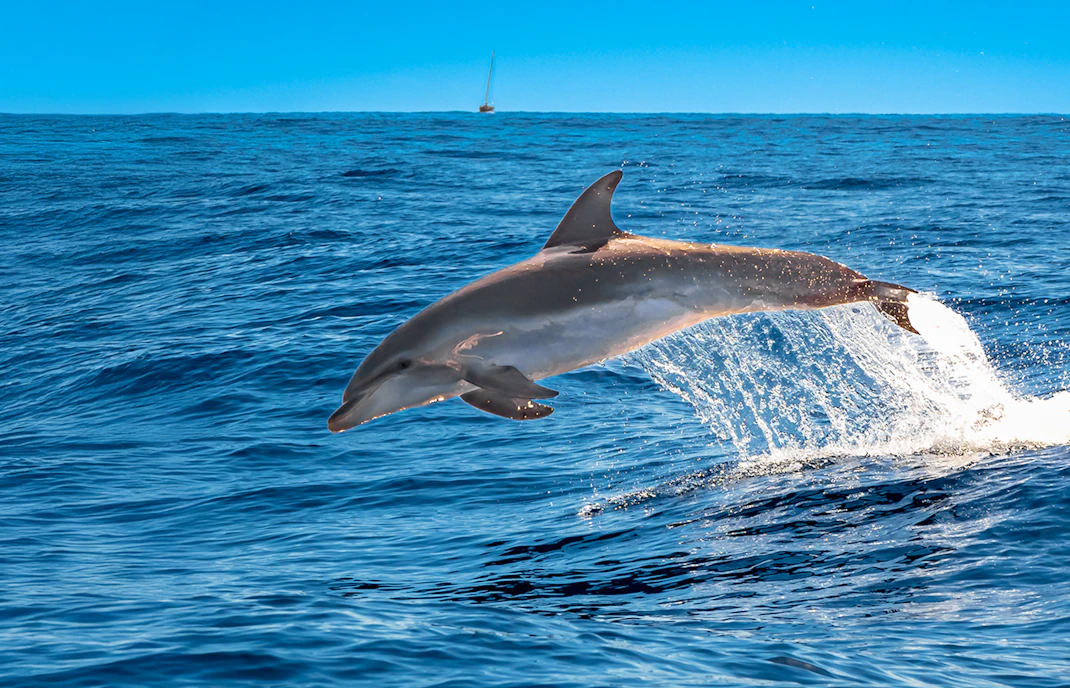
The common bottlenose dolphin (Tursiops truncatus) is a permanent resident of Tenerife's southwest coast, often observed in groups of 10 to 30 individuals. These sociable animals frequently interact with boats and can be found in coastal waters year-round.
Permanent Pilot Whale Population
Short-finned pilot whales (Globicephala macrorhynchus) maintain a stable resident population in the deep waters between Tenerife and La Gomera. Often exceeding 5 metres in length, they are among the most reliably sighted cetaceans in the region.
Teno-Rasca Special Conservation Area
This designated marine strip is a protected habitat recognized for its ecological importance to resident cetaceans. The area's steep underwater topography and nutrient-rich currents provide an ideal refuge for species that remain here all year.
Up to 21 Cetacean Species
Beyond the resident pods, Tenerife's location along major Atlantic migratory routes allows for the occasional sighting of various transient species. Observers may encounter anything from massive blue whales to elusive beaked whales during different seasons.
Strategic Geographical Advantage
The island's position in the Atlantic Ocean, combined with extreme seabed depths reaching 2,400 metres, supports high levels of biodiversity. Volcanic formations near the coast concentrate nutrients and prey, creating an essential feeding ground.
Seasonal Dolphin Visitors
While some species live here permanently, others like the Atlantic spotted dolphin and common dolphin are seasonal visitors. These species often appear in larger, more active groups to take advantage of the nutrient-rich waters during specific times of the year.
Role of Echolocation
Local cetaceans use sophisticated echolocation clicks and whistles to navigate and hunt in deep water. This biological ability is vital for their survival as they track prey like squid and fish across the complex volcanic terrain.
Marine Life Biodiversity
Tenerife's waters are not limited to cetaceans, as they also provide a home for loggerhead turtles and green sea turtles. These animals, alongside seabirds like yellow-legged gulls and shearwaters, contribute to the island's vibrant and interconnected marine ecosystem.
When Are There Dolphins In Tenerife For The Best Sightings?
Dolphin sightings in Tenerife remain consistent throughout the year, but the best arrival window is between 09:00 and 14:30. Choosing these hours provides the most favorable sea conditions for observation.
Morning Tours
Low volume of visitorsCalmer sea conditions, 22°C to 25°C
Early departures often encounter the smoothest waters of the day. This timing increases comfort for passengers while scanning the horizon.
Spring and Autumn
Moderate visitor numbersStable temperatures, 20°C to 26°C
These shoulder seasons offer a balance of temperate weather and high marine activity. The climate remains mild for extended time on the water.
Winter Months
Fewer visitorsCooler breezes, 18°C to 22°C
While sightings persist, sea states can be more variable during winter. Monitoring local weather reports remains helpful for planning.
Verdict: The best time to visit is during the morning arrival window of 09:00–14:30, ideally during the spring or autumn months for the most stable sea conditions.
Operating Hours To See If Are There Dolphins In Tenerife
The facilities at Puerto Colón operate daily to facilitate dolphin watching excursions. Boat departures are scheduled within the following standard hours.
| Monday | 09:00–18:00 | |
|---|---|---|
| Tuesday | 09:00–18:00 | |
| Wednesday | 09:00–18:00 | |
| Thursday | 09:00–18:00 | |
| Friday | 09:00–18:00 | |
| Saturday | 09:00–18:00 | |
| Sunday | 09:00–18:00 |
Are There Dolphins In Tenerife: Entry And Tour Costs
Access to the port area at Puerto Colón is free for all visitors. Any associated costs for whale and dolphin watching are determined solely by the private tour operators chosen for your excursion.
While port access is 0 EUR, total costs for marine observation depend entirely on the specific private tour operator and service level selected.
Getting To The Port Where Are There Dolphins In Tenerife
The primary departure point for marine excursions in Costa Adeje is Puerto Colón, located on the southwest coast of Tenerife. It is accessible via public transport networks and major island road arteries.
Titsa lines 467 or 473 to Estación Costa Adeje
TF-1 motorway, exit 73 towards Costa Adeje
Direct service to Puerto Colón entrance
Responsible Observation: Are There Dolphins In Tenerife And How To Respect Them
Tenerife's resident cetaceans depend on responsible observer behaviour to maintain their natural routines. Operators certified under the Blue Boat charter follow strict approach distances and time limits to minimise disturbance.
Do
- Keep voices low and movements calm on deck
- Stay seated during close encounters to avoid sudden shifts
- Follow crew instructions on positioning and photography angles
- Choose operators displaying the yellow Boat flag certification
- Report any rule violations to port authorities after your trip
Don't
- Don't swim with or attempt to touch wild dolphins
- Don't use flash photography or drones near marine mammals
- Don't throw food or objects into the water
- Don't book with vessels that chase or encircle pods
- Don't expect guaranteed sightings or specific species on demand
Check availability
Common Questions: Are There Dolphins in Tenerife?
Everything you need to know about are there dolphins in tenerife