
Quick answer
Costa Adeje is an upscale coastal resort municipality in southwest Tenerife, centered on Puerto Colón marina at 28.0897°N. The area enjoys 22–28°C year-round temperatures, minimal rainfall, and calm morning sea conditions that make it the island's primary whale-watching departure hub. The resort zone combines volcanic sand beaches, luxury hotels, and direct access to the resident pilot whale population in the adjacent Atlantic corridor.
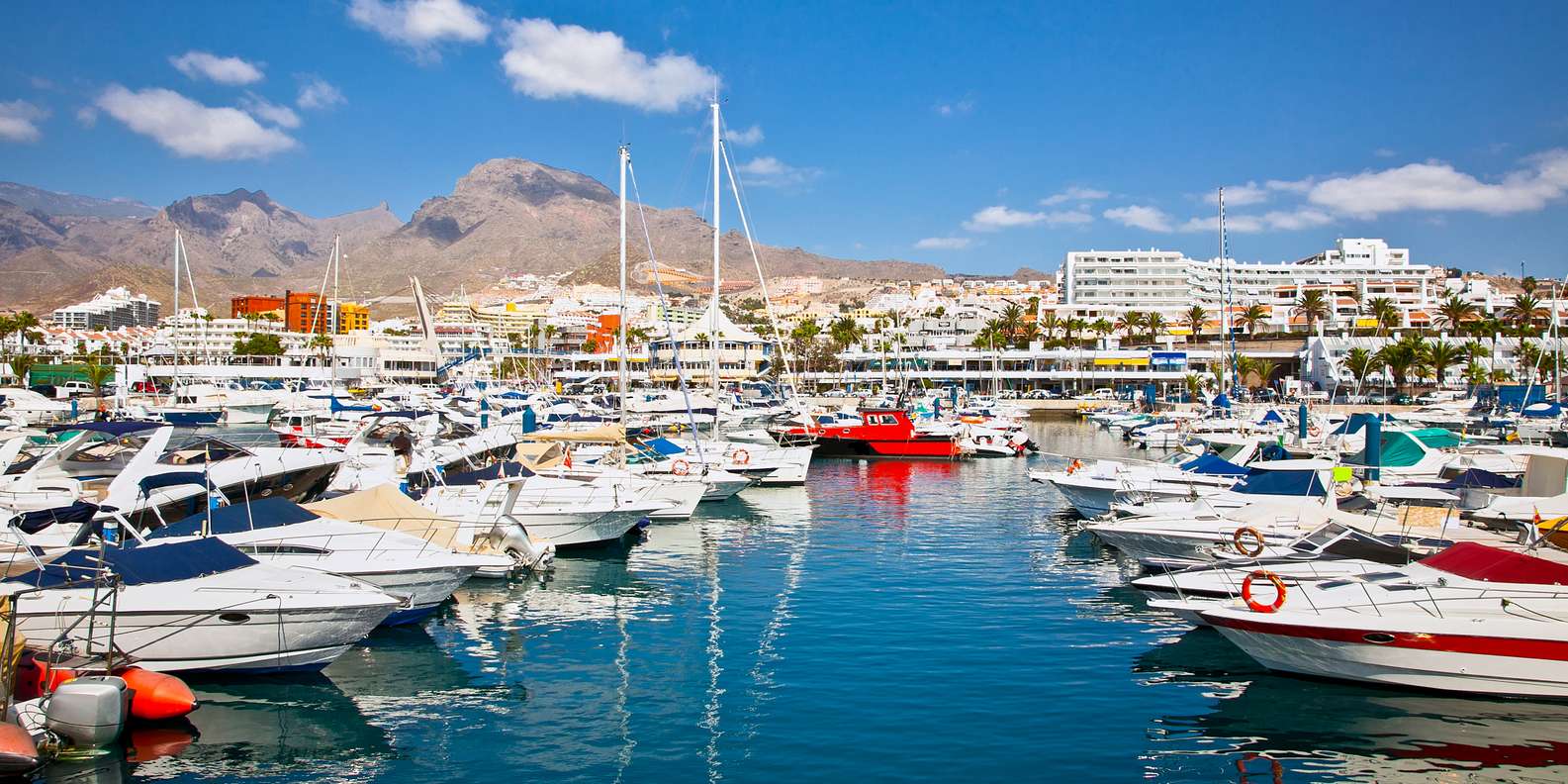
Puerto Colón sits at sea level where the Adeje coastal plain meets the Atlantic, protected by the Teide massif that blocks northeasterly trade winds and creates the microclimate responsible for 300 annual sunshine days. The harbor was developed in the 1980s as a purpose-built marina complex, and its western exposure to open ocean places it 8 nautical miles from the edge of the continental shelf—the depth transition where resident short-finned pilot whales and bottlenose dolphins congregate. What is Costa Adeje like in Tenerife comes down to three defining characteristics: year-round thermal stability, proximity to deep-water cetacean habitat, and infrastructure designed for marine tourism. Morning sea conditions between September and May average Force 2 on the Beaufort scale, with swell height under one meter. The volcanic seabed drops to 1,000 meters within 3 kilometers of the coastline, creating nutrient upwellings that sustain the prey species—mackerel and squid—that anchor the local food web. Pilot whales, designated as a resident population by the Canary Islands government since 1991, occupy this zone throughout the year. The resort itself runs along 7 kilometers of coastline, divided into named beaches—Playa del Duque, Playa de Fañabé, Playa de Torviscas—each fronted by promenades and tiered hotels. Puerto Colón anchors the southern end, its twin breakwaters sheltering a 400-berth marina that serves both private yachts and the commercial whale-watching fleet. The immediate harbor precinct contains embarkation points, marine education kiosks, and the regional office of the Atlantic Whale Foundation. Visitors planning dolphin and whale watching in Costa Adeje should understand that the experience is shaped entirely by the area's Atlantic exposure and bathymetric profile. The southwest coast faces the prevailing current, and morning departures coincide with offshore wind lulls and optimal light angles for surface observation. Operators licensed under the Canary Islands' Blue Boat certification depart from Avenida de Colón moorings at Puerto Colón, with most excursions returning within three hours. The free-entry marina district allows advance scouting of vessels and direct operator contact before booking. Costa Adeje's coastal character—compact, purpose-built, and oriented toward the cetacean corridor—makes it the logical base for travelers whose primary intent is marine wildlife observation rather than cultural or inland exploration.
“The volcanic seabed drops to 1,000 meters within 3 kilometers of the coastline, creating the nutrient upwellings that anchor the local cetacean population.”
What Is Costa Adeje Like In Tenerife For Whale Watching Timing
The best time for whale and dolphin watching in Costa Adeje is during the morning arrival window of 09:00–13:00, which offers the calmest sea conditions and optimal lighting for sightings. Resident pilot whales and dolphins remain in these waters throughout the year, allowing for consistent wildlife opportunities regardless of the season.
Spring (March–May)
Moderate crowdsMild 20°C–24°C; stable seas
Spring offers pleasant temperatures and calm waters ideal for excursions. Observations remain consistent as resident pods are frequently active.
Summer (June–August)
High crowdsWarm 26°C–29°C; dry climate
Visitor numbers increase during these months. Early departures are essential to manage increased maritime activity in the marina.
Autumn (September–November)
Moderate crowdsWarm 24°C–27°C; calm waters
Sea conditions often remain steady during this period. Lower visitor volume compared to summer provides a quieter experience on the water.
Winter (December–February)
Low to moderateMild 18°C–22°C; occasional wind
Cooler temperatures prevail, yet sightings persist. Mornings remain the most reliable time to encounter wildlife before afternoon breezes develop.
Verdict: For the most favorable sea conditions and lighting, aim for mid-week morning departures between 09:00–13:00 during the months of April or October.
What Is Costa Adeje Like In Tenerife: Operation Hours
The Puerto Colón marina is accessible 24 hours a day, seven days a week. This constant availability supports diverse excursion schedules throughout the year.
| Monday | 00:00–23:59 | |
|---|---|---|
| Tuesday | 00:00–23:59 | |
| Wednesday | 00:00–23:59 | |
| Thursday | 00:00–23:59 | |
| Friday | 00:00–23:59 | |
| Saturday | 00:00–23:59 | |
| Sunday | 00:00–23:59 |
Understanding What Is Costa Adeje Like In Tenerife Regarding Costs
Access to the marina at Puerto Colón is free of charge. Actual costs for whale and dolphin watching excursions are determined independently by each tour operator.
While marina entry is 0 EUR, visitors pay varying amounts for boat excursions based on the specific operator and tour selected.
How To Navigate What Is Costa Adeje Like In Tenerife For Excursions
Puerto Colón is situated along the main coastline of Costa Adeje, providing the primary departure point for whale and dolphin watching excursions. Access is straightforward via local transport or private vehicle using the TF-1 motorway.
Titsa lines 467 or 471 to Estación Costa Adeje
TF-1 motorway, exit 73 towards Costa Adeje
Direct service to Puerto Colón, Avenida de Colón
Follow the promenade from Playa de Torviscas
Interesting Facts About What Is Costa Adeje Like In Tenerife
The waters surrounding Costa Adeje are recognized as a permanent habitat for diverse cetacean populations, making this region a significant site for marine observation in the Atlantic. Its unique bathymetry creates an environment where deep-water species thrive in close proximity to the coastline.
21 species of cetaceans inhabit these waters
The geographic positioning between Tenerife and La Gomera provides a sheltered corridor for various whale and dolphin species, including the resident short-finned pilot whale.
Short-finned pilot whales remain year-round
Unlike migratory populations, a resident colony of short-finned pilot whales lives permanently in the channel between Tenerife and La Gomera.
1,500 meters of depth nearby
The ocean floor drops rapidly to depths of 1,500 meters or more just a few miles offshore, allowing deep-diving species to reside near the coast.
Bottlenose dolphins are frequent sightings
Bottlenose dolphins are commonly observed in the coastal zones, often displaying social behaviors near the surface in groups known as pods.
Oceanic currents support high biomass
The convergence of deep oceanic currents around the Canary Islands brings nutrients to the surface, supporting a robust marine food chain.
Geographical protection from trade winds
The southern coast of Tenerife benefits from the island's mountainous topography, which shields the area from prevailing trade winds and creates stable sea conditions.
Etiquette For What Is Costa Adeje Like In Tenerife Whale Watching
Marine wildlife protection laws and voluntary codes govern all excursions from Puerto Colón. Operators follow strict approach distances and engine protocols to minimize disturbance to cetaceans.
Do
- Follow crew instructions on viewing positions and movement around the boat
- Keep noise levels low when marine life is sighted nearby
- Dispose of all litter in designated bins on board
- Stay seated during approach maneuvers and when requested by the captain
- Apply reef-safe sunscreen before boarding to protect marine ecosystems
- Listen to the pre-departure safety briefing and note muster points
Don't
- Don't attempt to touch or feed dolphins or whales during encounters
- Don't use flash photography when animals surface close to the vessel
- Don't throw anything overboard, including biodegradable items or food waste
- Don't lean over railings or stand on seating during wildlife sightings
- Don't use drones without explicit permission from the operator and authorities
- Don't disembark until the crew confirms it is safe to do so
Check availability
Common Questions: What Is Costa Adeje Like in Tenerife?
Everything you need to know about what is costa adeje like in tenerife